Safety in Action 2013

We are pleased to announce that ChemAlert will be hosting an exhibit at Safety in Action (SIA) 2013. SIA will be held at the Melbourne Exhibition Centre this year, and runs from the 19th of March to the 21st of March. Please drop by and catch up with our friendly staff!

For more information about Safety in Action 2013, click here.

ChemAlert v3.3 Service Pack

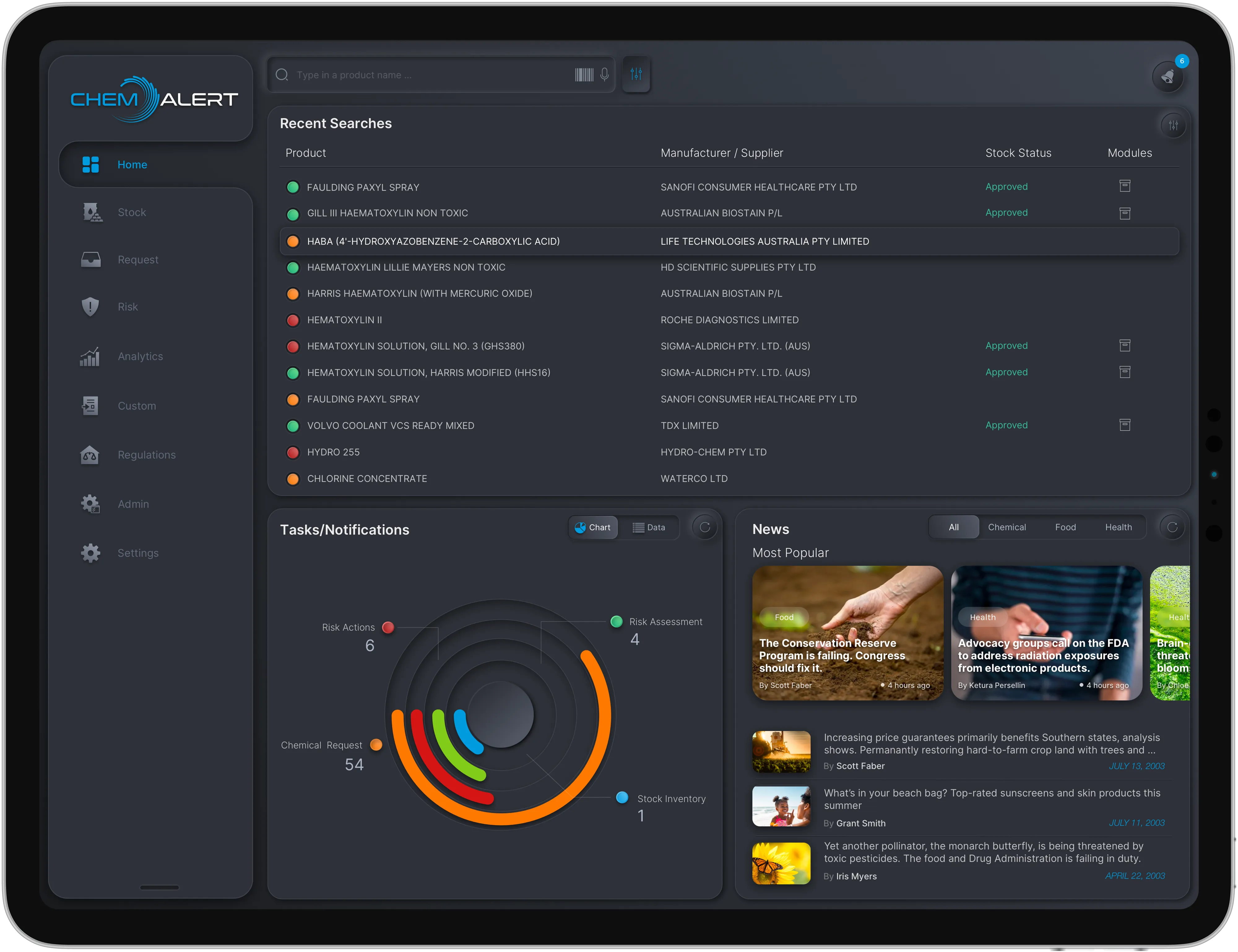
The ChemAlert v3.3 Multilingual / Service Pack has been finalised and is now available for download from our eDelivery site. To log into the eDelivery site, you need your Company Name and the Serial Number from your System Configuration certificate.  If you require assistance, please don't hesitate to contact us by emailing ChemAlert Support or calling (08) 9322 1711.

ChemAlert version 3.3 (July 2012)

ChemAlert v3.3 has now been released!  It has been a while since the last release of ChemAlert, but you’ll understand why when you see the new functionality and enhancements included in the new version.

Many of the new features and enhancements are a result of new legislative requirements, whislt others come directly from suggestions made by our clients. You will find a list of some of the most significant changes included in ChemAlert v3.3 below, all designed to make your job easier.

GHS Compliance and Control

The Globally Harmonised System of Classification and Labelling of Chemicals (GHS) is now in effect in many states of Australia and around the world. ChemAlert v3.3 contains a new suite of GHS reports and labels to assist in the transition from the old to new legislative framework. RMT’s scientists have been hard at work for the last two years classifying almost all of the existing products in the database with GHS data. Reports can be generated in either old or new format, or optionally disabled to allow control over which legislative framework you adhere to.

GHS

Risk Assessments and Controls

RMT has further expanded upon the extensive task-based Risk Assessment module enabling users to allocate many products to one risk assessment while individually assessing each product and the exposure risk it presents. At the task level, greater control has been given to the administrator to customise the controls assessment form, aligning the risk assessment process with the focus of the new Work Health and Safety legislation.

Stock and Risk Report Improvements

As part of RMT’s continuous improvement strategy, many stock reports have been enhanced for content and performance including;

• Storage Incompatibilities: Enhanced to factor minimum exemption limits as provided for in the legislative framework. It also includes a new summary page and optional appendix.

Storage


• Stock Holdings: Now available in two different formats, with the new default format containing more columns and information than ever before.

• CSV Reports: All CSV reports have been reviewed and reformatted with many additional columns to allow users to filter, sort and perform other custom reporting on the data contained within ChemAlert.

Chemical Request Improvements

A new advanced search feature and pagination has been added to the Chemical Request to make it easier to find new and existing Chemical Requests. Administrators can also customise the Chemical Request with their own blank template, more status options and shortcuts to add products to Stock once assessed and approved.

Easy Batch (Bulk) Printing

ChemAlert v3.3 introduces a new Batch Printing application that makes it easier to send many reports or manufacturer Safety Data Sheets (SDSs) to your printer. This application enables jobs to be split into smaller chunks, and for users to resume should an error occur.

More Reliable Access to SDSs

ChemAlert can now keep a cache of the manufacturer SDSs that you access on the local ChemAlert server meaning, should your Internet connection drop out, ChemAlert can still access the manufacturer’s SDS. Each time a user accesses a new or updated manufacturer SDS (including by Batch Printing), the file is updated in the local cache ensuring the cache is as up-to-date as possible if the unexpected does occur.

More Environmentally Friendly

On top of all these great enhancements, ChemAlert v3.3 is the first release that is predominantly distributed by electronic media rather than the creation of physical disks. Each year hundreds of millions of CDs and DVDs end up in landfill around the globe, and RMT is determined to do our part to reduce landfill. Utilising the ever increasing bandwidth available on the Internet, electronic delivery (eDelivery) also enables faster availability to our clients..

So when will you get to use these new features of ChemAlert? If you are a SaaS (Software as a Service) client, your ChemAlert system will be automatically upgraded. If you are hosting your own ChemAlert system, the eDelivery notification should have been emailed to your ChemAlert administrator in mid July.

If you would like more information regarding the ChemAlert upgrade process, please contact our ChemAlert Support Team on casupport@rmt.com.au or call +61 8 9322 1711.

For ChemAlert v3.3 Public Training dates, please click here or contact our Training Department on training@rmt.com.au.

If you would like any more information regarding ChemAlert training, implementation services, or SaaS hosted solution, please don’t hesitate to contact one of our Sales team members on info@rmt.com.au or +61 8 93221711.

Diesel Exhaust Fumes (June 2012)

On 12th June 2012, the International Agency for Research on Cancer (IARC) classified diesel engine exhaust as carcinogenic to humans.

Background
The classification was based on sufficient evidence that exposure to diesel fumes is associated with an increased risk of lung cancer. The revised classification comes after a thorough review of scientific evidence and a week-long meeting of international experts in France earlier this month.

IARC had previously (1998) classified diesel exhaust as probably carcinogenic to humans. However, there has been mounting concern about the cancer-causing potential of diesel exhaust which led to the re-evaluation of the health effects of exposure to diesel emissions.

IARC found that diesel exhaust is a cause of lung cancer (sufficient evidence) and also noted a positive association (limited evidence) with an increased risk of bladder cancer.

The revised classification places diesel exhaust in the same category as other known carcinogens such as asbestos, tobacco smoke and UV radiation and has significant public and occupational health implications.

What is Diesel Engine Exhaust?
Diesel engine exhaust is a complex mixture of airborne particles and gases. Diesel particulate matter (DPM) is the particulate component of diesel exhaust, which includes diesel, soot and aerosol particulates.

Hazmat (9 to 10 May 2012 - Melbourne, Victoria)

ChemAlert has been to Hazmat 2012.  We recommended the Hazmat event for people wanting more information about the safe handling of hazardous chemicals.  More information about the Hazmat conference can be found at the Fire Protection Associate Australia website: www.fpaa.com.au.

SIA Tradeshow (17 to 19 April 2012 - Melbourne, Victoria)

ChemAlert hosted a stand (I12) at the Safety In Action tradeshow at the convention centre in Melbourne.  We invited everyone to come and meet with us.  Kevin Harris (Account Manager) and Brad Cobb (ChemAlert Design) attended to the stand and answered questions, received comments and feedback, and generally had a chat to everyone there.  More information about the SIA tradeshow can be found at the Safety Institute of Australia website: www.sia.org.au.

AOG Conference (22 to 24 Feb 2012 - Perth, WA)

ChemAlert hosted a stand (F1) at the Australasian Oil & Gas Exhibition & Conference, demonstrating ChemAlert Mobile in one of the new 'innovation pods' #13 located in the Innovation Zone.  Over the course of the conference, we had many staff at the stand including; Scientists, Account Managers, Business Analysts, and Trainers. More information about the AOG conference can be found at: www.aogexpo.com.au

ChemAlert Mobile Lite for iPhone/iPad (January 2012)

ChemAlert Mobile Lite released on the Apple App Store to service the needs of people wanting core health & safety information on 100,000+ chemicals without the need for SDS compliance or ChemAlert reports.  Information includes properties, first-aid information, risk & safety phrases, Personal Protective Equipment (PPE) details, ADG classifications, and GHS classifications.

GHS in Australia (1 January 2012)

From the 1st of January 2012, new legislation has come into effect on the classification of chemicals; GHS.  This legislation has a 5 year transitional period, although some states in Australia have declined to approve the legislation due to the late release of the approved legislation.  For more information regarding GHS in Australia, click here to go to the SafeWork Australia website.

ChemAlert Mobile for iPhone/iPad (July 2011)

ChemAlert Mobile released on the Apple App Store today to service the needs of people needing mobile access to core health and safety information as well as Safety Data Sheets and independantly-researched reports.  Information includes properties, first-aid information, risk & safety phrases, Personal Protective Equipment (PPE) details, ADG classifications, and GHS classifications, ChemAlert Full Report, and Manufacturer Safety Data Sheets.